


When Does It Make Sense to Hire In-House vs Freelancers vs an Agency?
At some point, almost every brand growing on Amazon hits the same question:
Do we hire someone in-house, work with freelancers, or bring in an agency?
It’s a reasonable dilemma. Each option can work well — and each can go badly wrong — depending on timing, expectations, and how the role is actually used. The mistake most brands make isn’t choosing the “wrong” model, but choosing the right model at the wrong stage.
Let’s walk through each option in practical terms.
Hiring In-House: When Control and Integration Matter Most
Hiring in-house usually makes sense once Amazon is already an established revenue channel. If Amazon is a core part of the business — not just an experiment — having someone internally who lives and breathes the account can be a big advantage.
An in-house hire understands the brand, the margins, the supply chain constraints, and internal priorities in a way no external partner ever fully will. Communication is easier, alignment is tighter, and decisions can be made quickly without layers of back-and-forth.
Where this often breaks down is expectations. Many brands hire one “Amazon Manager” and expect them to be a full-stack growth engine: PPC expert, creative strategist, data analyst, DSP specialist, and international expansion lead all in one. In reality, most people are strong in one or two areas and average in the rest.
There’s also the fixed-cost reality. Salaries, tax, benefits, tools, training, and management time add up quickly — and if that person leaves, momentum often takes a hit.
Pros
- Deep understanding of your brand and business
- Strong internal alignment and communication
- Full control over priorities and execution
Cons
- High fixed cost and long-term commitment
- Limited breadth of expertise in one hire
- Knowledge and performance risk if they leave
Freelancers: Flexible Help, Narrow Ownership
Freelancers are often misunderstood. Used correctly, they’re extremely effective. Used incorrectly, they create fragmentation and frustration.
They work best when you have a specific, clearly defined problem to solve. Maybe your listings need a rebuild, your PPC needs an audit, or you need specialist creative or DSP support. For these types of projects, freelancers can be fast, skilled, and relatively low risk.
The issue comes when freelancers are expected to “own” growth. Most freelancers focus on their narrow scope, not the broader strategy. When you have multiple freelancers across PPC, creative, and optimisation, someone still needs to connect the dots — and that usually ends up being the brand owner or internal team.
If you already know what needs to be done and just need capable execution, freelancers make sense. If you’re unsure about direction, they rarely provide that clarity.
Pros
- Flexible and lower commitment
- Access to niche or specialist skills
- Cost-effective for short-term or defined work
Cons
- Strategy often sits with you
- Fragmented execution across roles
- Limited proactive growth ownership
Agencies: Speed, Structure, and Broader Perspective
Agencies tend to become attractive when Amazon complexity increases. More SKUs, higher ad spend, tighter margins, international expansion — at this point, speed and structure start to matter more than pure cost.
The real value of an agency isn’t just execution. It’s exposure to patterns across dozens or hundreds of accounts, faster testing cycles, and multiple specialists working together. Instead of relying on one person’s experience, you’re tapping into a team that’s seen similar problems before.
That speed can be critical. When the cost of slow decision-making is high, an agency often pays for itself simply by helping you move faster and avoid common mistakes.
That said, agencies aren’t a silver bullet. They require clear communication, trust, and alignment. And not all agencies operate at a strategic level — some are better suited to execution than leadership.
When used as a genuine partner rather than a task list, agencies are often the quickest route to scale.
Pros
- Team-based expertise across multiple disciplines
- Faster testing and learning cycles
- Broader strategic perspective from multiple accounts
Cons
- Higher monthly cost than freelancers
- Requires strong communication and alignment
- Quality varies significantly between agencies
Why Hybrid Models Often Work Best
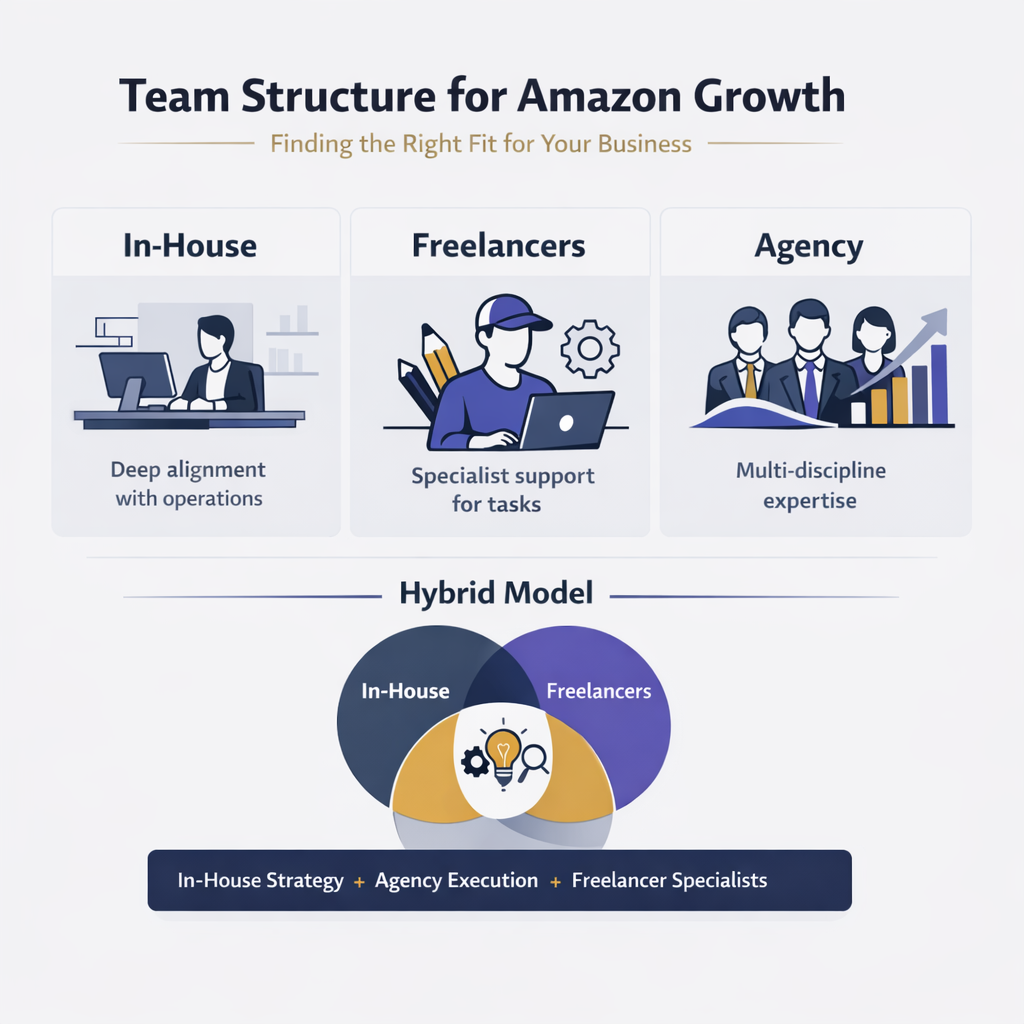
As brands grow, many end up combining these approaches. A common setup is an in-house Amazon or marketplace lead who owns the channel internally, supported by an agency for PPC and strategy, with freelancers used for creative or specialist projects.
This reduces dependency on any single person or partner while keeping control, speed, and expertise balanced. It’s not always the cheapest model — but it’s often the most resilient.
The Question That Actually Matters
Instead of asking, “Which option is cheaper?” the better question is:
“What’s holding growth back right now?”
If execution is slow, you may need specialist help.
If strategy is unclear, outside perspective often helps most.
If coordination is the bottleneck, an in-house role may be right.
If testing isn’t happening fast enough, agencies tend to excel.
The best decision usually becomes obvious once you’re honest about the constraint.


