


Brand Tailored Promotions: When They Matter (And When They Don’t)
Amazon doesn’t release features unless they serve its own objectives. Brand Tailored Promotions are no different.
On the surface, they look simple: discounts targeted at specific customer segments such as repeat buyers, high spenders, or recent viewers. In practice, they can be far more strategic — if used correctly.
Most sellers either ignore them or use them incorrectly.
What Brand Tailored Promotions Actually Do
Brand Tailored Promotions allow you to create percentage discounts for specific audience segments inside your brand ecosystem.
You can target:
- Repeat customers
- High-spend customers
- Recent brand buyers
- Customers who viewed your products but didn’t purchase
Unlike public coupons or deals, these are audience-specific. They aren’t broadcast to the entire marketplace. They’re targeted at customers who already have some level of engagement with your brand.
That distinction matters.
This isn’t a traffic tool. It’s a conversion and retention tool.
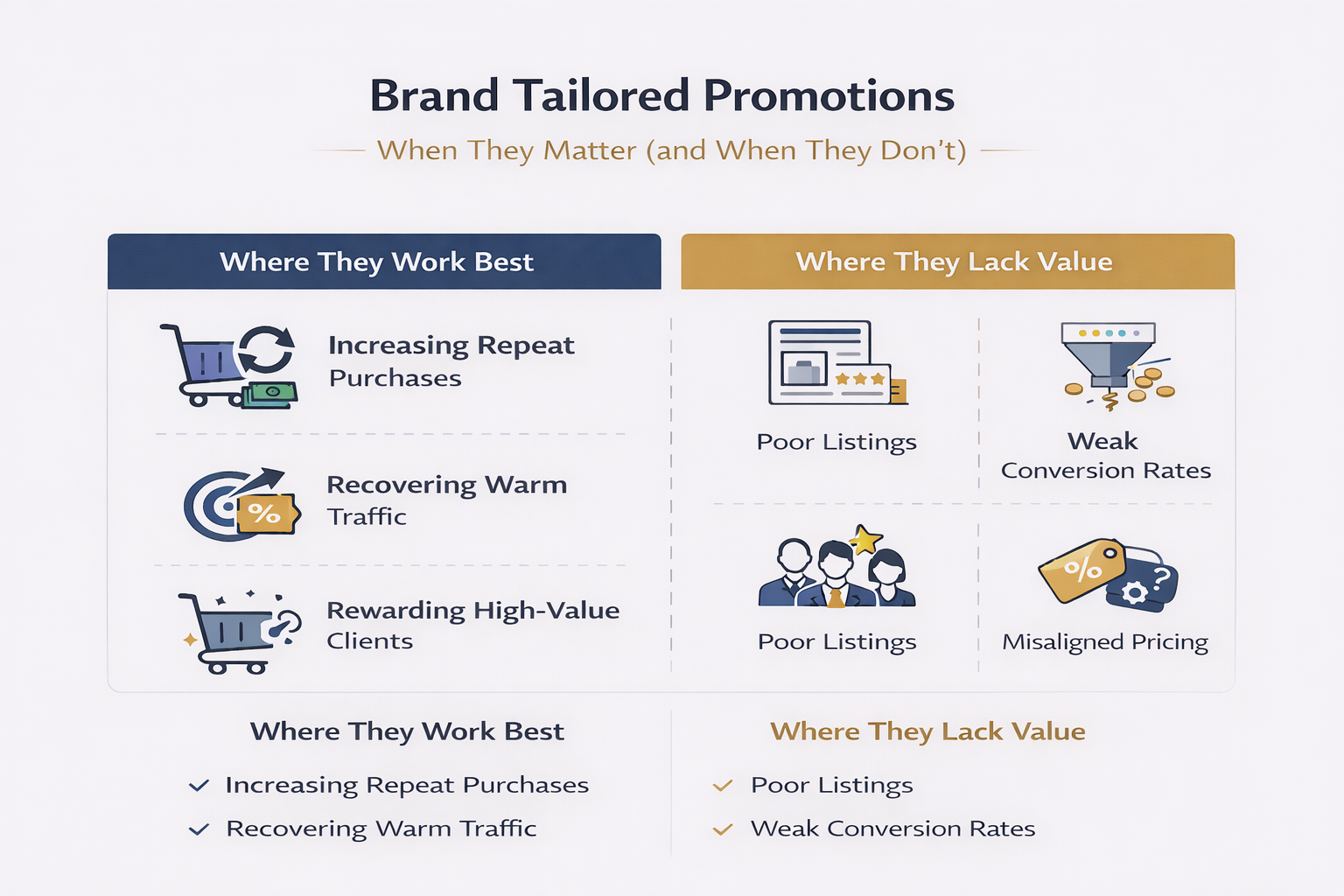
Where They Work Best
Brand Tailored Promotions are strongest in three scenarios:
1. Increasing Repeat Purchase Rate
If you sell consumables or products with natural repurchase cycles, this is one of the cleanest uses.
Instead of relying purely on PPC to reacquire your own customers, you can incentivise repeat behaviour directly.
Used correctly, this improves lifetime value without inflating acquisition cost.
2. Recovering Warm Traffic
Customers who viewed your product but didn’t convert are high-intent traffic.
If your listing is strong and price resistance was the likely objection, a targeted promotion can convert some of that traffic without publicly discounting your entire listing.
This is particularly useful in competitive categories where small pricing differences influence conversion.
3. Rewarding High-Value Customers
Not all customers are equal.
High-spend buyers are disproportionately valuable. Offering them occasional incentives can reinforce brand preference without running aggressive public discounts.
It’s retention logic, not revenue desperation.
Where They Don’t Add Much Value
Brand Tailored Promotions won’t fix:
- Poor listings
- Weak conversion rates
- Bad reviews
- Misaligned pricing
- Structural PPC inefficiencies
They are not a substitute for fundamentals.
If your product isn’t converting, discounting specific segments rarely solves the underlying issue. It simply compresses margin.
Margin Considerations
The biggest mistake with tailored promotions is using them casually.
Because they feel “targeted,” sellers sometimes ignore margin impact. But the economics still apply. Every discount reduces contribution margin.
Before running them, you should understand:
- Your true SKU-level margin
- Your repeat purchase rate
- Your blended TACoS
- Whether retention discounting improves lifetime value or simply reduces profit
If the promotion is accelerating profitable behaviour, it makes sense. If it’s compensating for structural weakness, it doesn’t.
How We Think About Them
We view Brand Tailored Promotions as a retention lever, not a growth lever.
They are useful when:
- The brand already converts well
- Customer data volume is meaningful
- Repeat behaviour is part of the model
- Margins allow for controlled incentives
They are less useful at early launch stages where traffic and ranking are the main constraints.
In simple terms, they are a refinement tool — not a primary strategy.
Final Thought
Most Amazon features are neutral. They’re only powerful when placed in the right context.
Brand Tailored Promotions can increase retention, improve lifetime value, and recover warm traffic — but only if the fundamentals are already solid.
Used strategically, they sharpen performance.
Used reactively, they just reduce margin.
If you’d like, I can:
- Turn this into a more tactical “how to structure” guide
- Add example discount frameworks by category
- Or write the complementary post on Brand Follow + Customer Engagement tools


